
UNU Jogja Students Create PID-Based Automatic Hydroponic System, Control Plant Nutrition Through Excel Only
Published by Latifatussolikhah, 12 Aug, 2025
Est. 2 Minutes
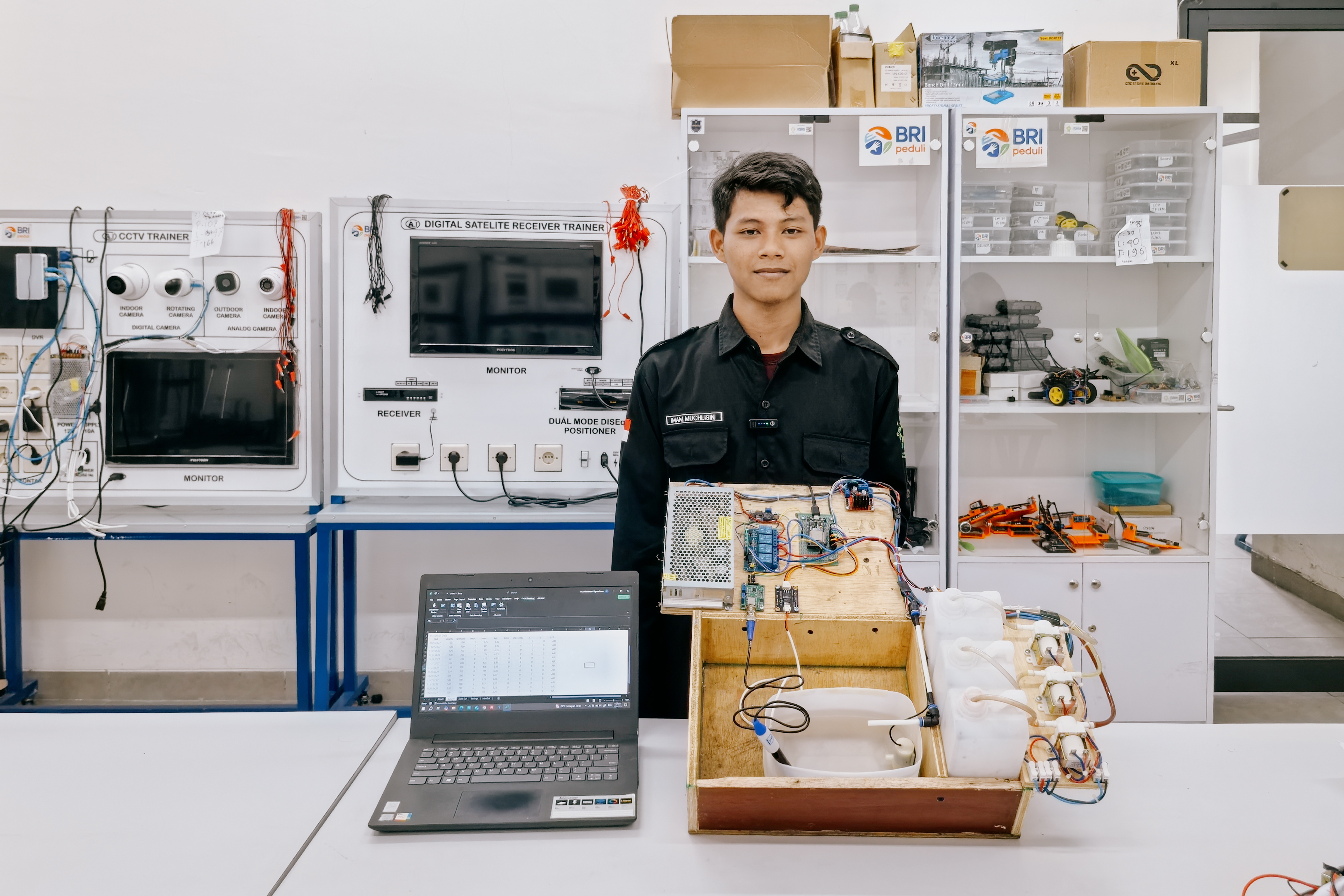
Yogyakarta, Indonesia – Imam Muchlisin, a student from the Electrical Engineering Study Program at Nahdlatul Ulama University (UNU) Jogja, under the supervision of lecturer Irwan Novianto, has developed an innovation in modern agricultural technology: an Automatic Hydroponic Nutrient Mixing System based on a Proportional–Integral–Derivative (PID) controller. The system is designed to help hydroponic farmers precisely manage nutrient compositions with greater ease.
The system integrates key components such as an ESP32, pH sensor, TDS sensor, flow sensor, solenoid valve, pump, relay, and L298N motor driver. Its standout feature is the ability to receive direct input from Microsoft Excel, allowing users to enter volume and nutrient concentration (ppm) values easily and effectively.
Once the data is entered, the ESP32 processes the information, relying on real-time readings from the TDS and flow sensors to monitor nutrient conditions. The mixing process then runs automatically through the PID control system, with the final mixture stored in a reservoir before being distributed to the hydroponic installation.
According to Imam, the PID-based control system ensures more accurate and efficient nutrient mixing compared to manual methods. “With this system, human error in measurement and mixing can be minimized. The goal is to help farmers save time while maintaining plant quality,” he explained.
Though still in development, the project stands out for its integration of ESP32 with a Microsoft Excel interface, PID control, and various sensors—offering a unique approach that opens new possibilities for Internet of Things (IoT) applications in hydroponic automation.
Supervisor Irwan Novianto highlighted that the system’s integration of ESP32, pH/TDS/flow sensors, and PID control with Excel input provides both precision and ease of use. “After regular calibration and field testing, this system could be widely adopted. It offers tangible benefits for farmers—more accurate mixing, shorter working time, reduced human error, and more consistent crop quality,” he said.
This innovation is expected to become a practical solution for both household and commercial hydroponic farmers, contributing to the modernization of Indonesia’s agricultural sector. [Latifah]
Share
Related News
-1776930738782.png?alt=media&token=fa1c550b-563f-4750-a691-45d6389558ea)
Supporting Indonesia Emas Vision, UNU Jogja Earns Special Jury Recognition at QS Impact Skills Challenge 2026 with Educational Game Innovation
Published by Latifatussolikhah, 21 Apr, 2026 | Duration. 3 Minutes

UNU Yogyakarta Students Actively Master Technology, Hold OpenClaw Tech Discussion with Experts
Published by Latifatussolikhah, 14 Apr, 2026 | Duration. 2 Minutes

Interdisciplinary Islamic Studies Program at UNU Yogyakarta Achieves “Very Good” Accreditation
Published by Latifatussolikhah, 8 Apr, 2026 | Duration. 2 Minutes
PGSD Student of UNU Jogja Wins 3rd Place in DIY-Level Da’i Competition
Published by Latifatussolikhah, 9 Mar, 2026 | Duration. 2 Minutes
Popular News
Strengthening Academic Excellence, Management Department Lecturer of UNU Jogja Successfully Completes Doctoral Studies
Published by Latifatussolikhah, 27 Apr, 2026 | Duration. 1 Minutes
Supporting Indonesia Emas Vision, UNU Jogja Earns Special Jury Recognition at QS Impact Skills Challenge 2026 with Educational Game Innovation
Published by Latifatussolikhah, 21 Apr, 2026 | Duration. 3 Minutes
Congratulations! UNU Jogja Lecturers from Primary Education and Agribusiness Earn Doctoral Degrees
Published by Latifatussolikhah, 22 Apr, 2026 | Duration. 1 Minutes
UNU Jogja Proud as Two Lecturers Earn Doctoral Degrees in Animal Science and Humanities
Published by Latifatussolikhah, 23 Apr, 2026 | Duration. 1 Minutes