
UNU Jogja Agribusiness Program Encourages Students to Understand Agrarian Reform through Public Lecture with Prof. Jamhari
Published by Latifatussolikhah, 15 Dec, 2025
Est. 3 Minutes
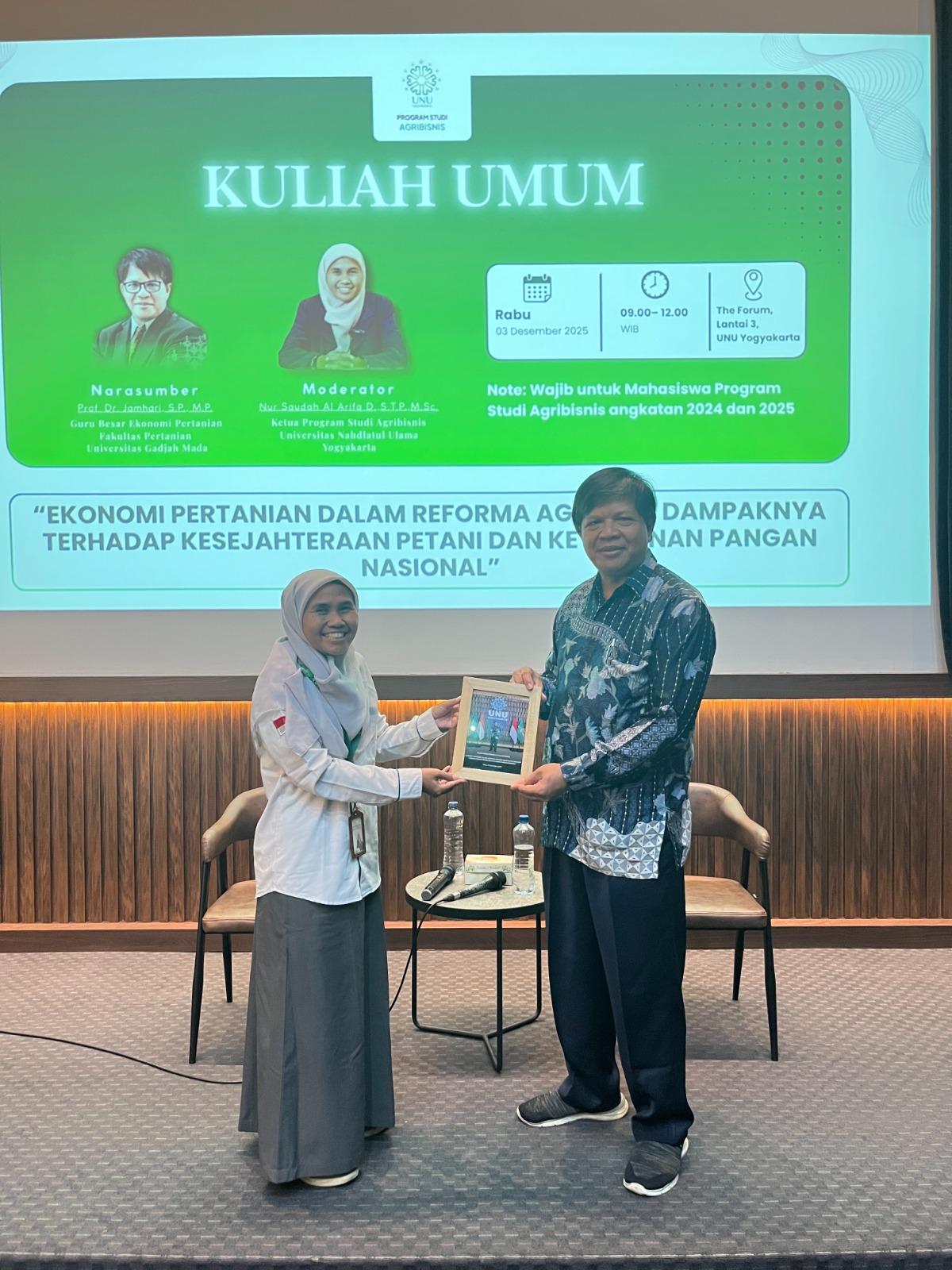
Yogyakarta, Indonesia — The Agribusiness Study Program of UNU Jogja continues to encourage students to strengthen their understanding of agrarian reform as a crucial component of sustainable agricultural development. One such effort was realized through a public lecture delivered by Prof. Jamhari, S.P., M.P., Professor at the Faculty of Agriculture, Universitas Gadjah Mada (UGM).
The public lecture, titled “Agricultural Economics in Agrarian Reform: Its Impact on Farmers’ Welfare and National Food Security,” was attended by all Agribusiness students and took place at The Forum Hall, UNU Yogyakarta Campus, on Wednesday, December 3.
Head of the Agribusiness Study Program, Nur Saudah Al Arifa D., S.T.P., M.Sc., stated that the lecture reflects the program’s commitment to strengthening agrarian literacy and enhancing students’ analytical capacity.
“We recognize that understanding agricultural economics within the context of agrarian reform is a strategic foundation for students, enabling them to design innovative solutions for improving farmers’ welfare and building a resilient national food system,” she said.
She further emphasized the program’s commitment to continuously providing inspiring, relevant, and constructive academic forums to produce graduates who are competent, competitive, and sensitive to strategic issues in Indonesia’s agricultural development.
Agrarian Reform as the Foundation of Agricultural Development
In his presentation, Prof. Jamhari highlighted the importance of agrarian reform as a fundamental pillar for achieving fair and sustainable agricultural development in Indonesia. He explained that unequal land tenure structures, rooted in the colonial era, have long been the source of various agrarian problems, including rural poverty, low agricultural productivity, resource conflicts, and the fragility of national food security.
“Agrarian reform is not merely about land distribution. It is a comprehensive effort to restructure justice, provide legal certainty, and improve farmers’ welfare,” he emphasized.
Prof. Jamhari further outlined the long history of Indonesia’s agrarian policies, from the pre-1960 Basic Agrarian Law (UUPA) period, the enactment of the Basic Agrarian Law in 1960, to the dynamics of the 1998 Reform Era, which revived land access equity as a national agenda. According to him, the resurgence of agrarian reform during the Reform Era laid the foundation for the National Agrarian Reform Agenda launched in 2016, which remains the most comprehensive implementation since the enactment of the Basic Agrarian Law.
The agenda comprises two major programs: the redistribution of Agrarian Reform Land Objects (TORA) covering 9 million hectares derived from unproductive state land, abandoned land, forest area releases, and former plantation concession land; and the Social Forestry program covering 12.7 million hectares, granting communities 35-year forest management rights through various schemes, including village forests, community forests, customary forests, people’s plantation forests, and forestry partnerships.
He stressed that both programs aim not only to ensure equitable land access but also to promote empowerment through assistance, asset legalization, access to capital, and entrepreneurship training. These efforts are expected to strengthen farmers’ capacity, increase the income of forest-dependent communities, and support ecosystem restoration as well as agroforestry-based food systems.
The lecture was conducted in a dynamic and interactive atmosphere. Students actively raised critical questions regarding the effectiveness of TORA implementation, mechanisms for resolving agrarian conflicts, and opportunities for young people to develop modern farming enterprises amid evolving policy landscapes. The discussion provided meaningful reflection on the strong linkages between agrarian reform, agricultural economics, and national food security. [Latifah]
Share
Related News

Fasting and Mental Health: UNU Yogyakarta Lecturer Explains Ramadan’s Role in Students’ Emotional Stability
Published by Latifatussolikhah, 4 Mar, 2026 | Duration. 5 Minutes

Safe Fasting, Medication Continues: UNU Jogja Pharmacy Lecturer Highlights the Importance of Adjusting Medication Schedules During Ramadan
Published by Latifatussolikhah, 27 Feb, 2026 | Duration. 3 Minutes
Ramadan Against the Culture of Social Media Scrolling: Time for Students to Rise as Muslim Creators with Purpose
Published by Latifatussolikhah, 23 Feb, 2026 | Duration. 3 Minutes
UNU Jogja Adds to Its Doctoral Ranks, Agribusiness Lecturer Researches Eco-Efficiency of Dairy Farming in Sleman
Published by Latifatussolikhah, 18 Feb, 2026 | Duration. 3 Minutes
Popular News
UNU Yogyakarta Marks 9th Anniversary, Enters Consolidation Phase to Strengthen Its Accelerated Growth
Published by Latifatussolikhah, 12 Mar, 2026 | Duration. 3 Minutes
PGSD Student of UNU Jogja Wins 3rd Place in DIY-Level Da’i Competition
Published by Latifatussolikhah, 9 Mar, 2026 | Duration. 2 Minutes
UNU Jogja Community Wins Multiple Awards at LPTNU Awards 2026
Published by Latifatussolikhah, 10 Mar, 2026 | Duration. 3 Minutes
Explore the Future of the Sports Industry at GSIC Summit APAC 2026!
Published by Latifatussolikhah, 5 Mar, 2026 | Duration. 2 Minutes